


Why do solid-state NMR samples need to spin, and why is the rotor tilted at exactly 54.74°?
Magic-angle spinning, or MAS, is one of the defining techniques of solid-state NMR. By rotating the sample rapidly at a specific angle relative to the main magnetic field, MAS can average many orientation-dependent interactions and dramatically narrow otherwise broad solid-state NMR lines.
This guide focuses on four practical questions: why solid samples need to spin, why the angle is fixed near 54.74°, what happens to the spectrum as spinning speed increases, and what MAS cannot remove.
Why Do Solid-State NMR Samples Need to Spin?
Liquid-state NMR often produces sharp spectral lines because molecules undergo rapid isotropic motion. In low-viscosity liquids, molecules can reorient extremely quickly, allowing orientation-dependent interactions such as chemical shift anisotropy, or CSA, and dipolar coupling to be averaged efficiently.
As a result, liquid-state spectra are dominated by orientation-independent isotropic chemical shifts, which is one reason their lines are typically narrow.
Solid samples do not have this natural averaging mechanism. Molecular motion is restricted, and crystallites or local structural units remain in many different orientations relative to the magnetic field. Each orientation can therefore contribute a slightly different resonance frequency.
When signals from a large number of orientations are superimposed, the result can be a powder pattern extending over tens or even hundreds of kilohertz. Fine chemical-shift information may then be buried inside this broad envelope.
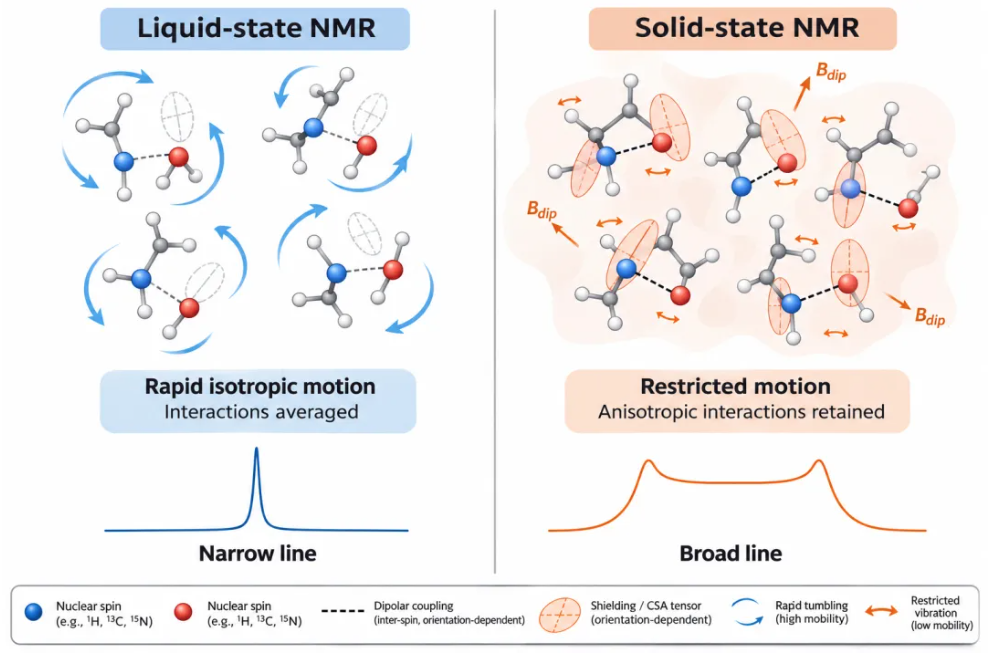
Figure 1. Comparison of Molecular Motion and Spectral Line Broadening in Liquid-State and Solid-State NMR
The idea behind MAS is straightforward: if the molecules in a solid cannot tumble freely, rotate the entire sample instead.
The solid sample is packed into a cylindrical rotor and spun rapidly using compressed gas. This controlled mechanical rotation creates a time-dependent averaging effect that can mimic part of the orientation averaging found naturally in liquids.
Why Is the Magic Angle 54.74°?
The magic angle is the angle between the rotor axis and the main magnetic field, B0. Its theoretical value is approximately 54.736°, commonly written as 54.74°.
In a solid powder, the resonance frequency of each crystallite can be separated conceptually into an isotropic contribution and an anisotropic contribution. The anisotropic part depends on the spatial orientation of the crystallite and is responsible for much of the broadening observed in solid-state spectra.
For many first-order anisotropic interactions, including CSA, dipolar coupling, and first-order quadrupolar interactions, this angular dependence contains the second-order Legendre polynomial:
P2(cosθ) = 1/2 (3cos2θ − 1)
Here, θ is the angle between the rotor axis and B0. To eliminate the time-averaged first-order anisotropic contribution, this angular factor must become zero:
3cos2θ − 1 = 0
cosθ = 1/√3
θ ≈ 54.736°
This is why 54.74° is not simply an experimentally chosen value. It is the geometric zero of the second-order Legendre polynomial for these first-order orientation-dependent interactions.
Geometrically, the same angle also corresponds to the angle between the body diagonal [111] of a cube and one of its principal axes.
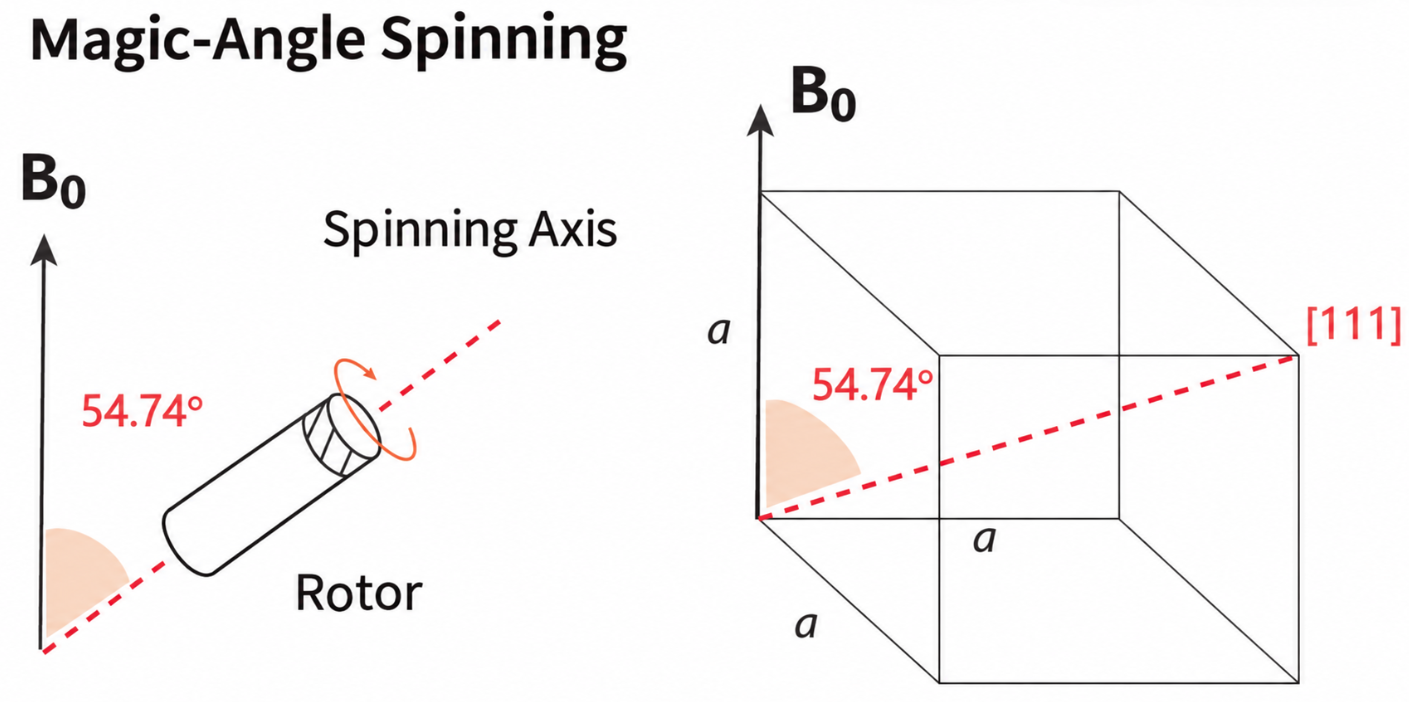
Figure 2. Geometry of the 54.74° Magic Angle Relative to the Main Magnetic Field
The Magic Angle Must Be Calibrated in Real Experiments
In practice, the rotor angle must be calibrated carefully. Even a small deviation from the theoretical value can leave residual anisotropic broadening.
The exact tolerance depends on the probe, nucleus, and linewidth being measured. A commonly used calibration material is KBr, where changes in the 79Br signal can be used to assess whether the magic angle has been set correctly.
What Happens to the Spectrum When the Sample Starts Spinning?
After the magic angle has been set correctly, the original broad powder pattern does not always collapse immediately into a single narrow peak. Instead, the spectrum is often redistributed into a centerband and a series of spinning sidebands.
- Centerband: For spin-1/2 nuclei dominated by CSA, the centerband corresponds to the isotropic chemical shift and does not move when the spinning speed changes.
- Spinning sidebands: Peaks appear on both sides of the centerband. The frequency spacing between adjacent sidebands equals the rotor spinning frequency.
For example, at a spinning speed of 10 kHz, neighboring spinning sidebands are separated by 10 kHz.
How Spinning Speed Changes the Spectrum
Spinning speed has a major effect on the appearance of a MAS spectrum.
Low-speed MAS: Sidebands remain dense and the overall spectral envelope can still resemble the static powder pattern. In this regime, the centerband may not even be the strongest peak.
Intermediate-speed MAS: As the rotor speed increases, the sidebands move progressively farther away from the center of the spectrum and their intensities decrease.
Very-high-speed MAS: When the spinning frequency approaches or exceeds the characteristic width of the anisotropic interaction, sideband intensities can become much weaker and most of the signal intensity becomes concentrated in the centerband. For CSA-dominated spin-1/2 nuclei, the resulting spectrum can approach a liquid-like appearance.
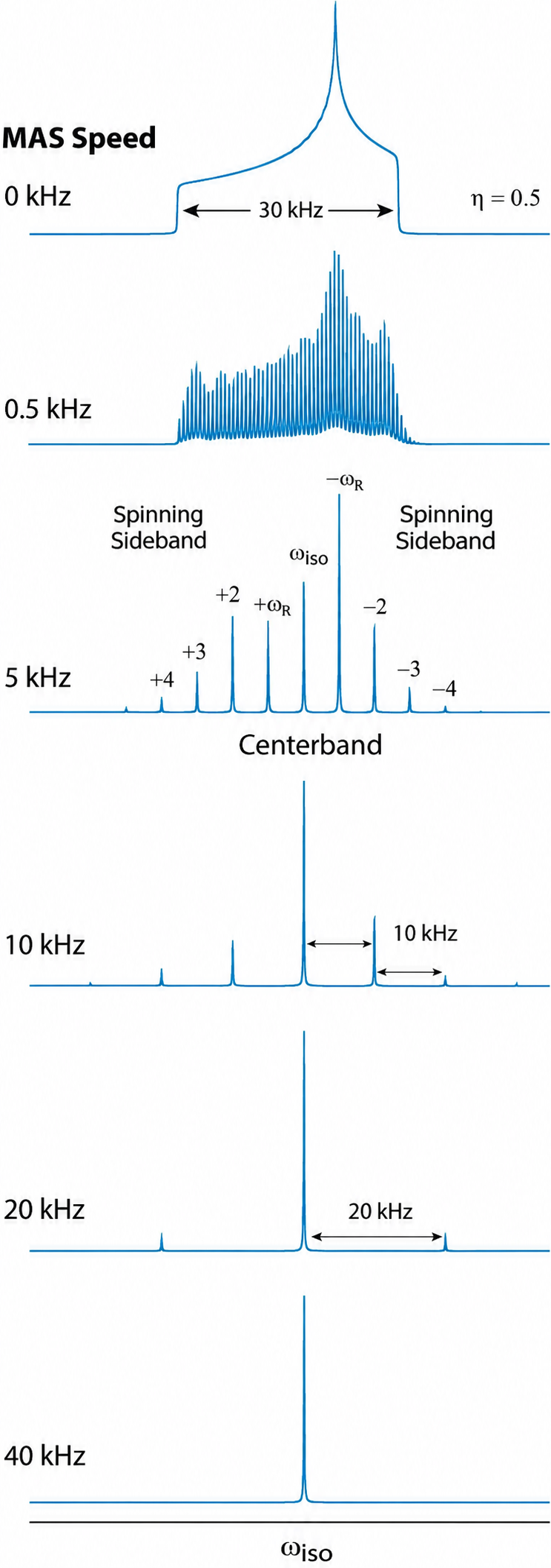
Figure 3. Evolution of the Centerband and Spinning Sidebands with Increasing MAS Frequency
A Practical Way to Identify Spinning Sidebands
How can you tell whether a peak is a true isotropic signal or a spinning sideband?
One practical method is to repeat the measurement at a different spinning speed.
For example, if the rotor speed is changed from 10 kHz to 12 kHz, a peak that remains at the same chemical shift position is the centerband. Peaks that move as the rotor frequency changes are spinning sidebands.
Two Important Points About Spinning Sidebands
First, spinning sidebands are not impurity peaks. They result from the periodic modulation of the resonance frequency by sample rotation and are therefore part of the sample's own NMR signal.
Their intensity distribution still contains information about the magnitude of chemical shift anisotropy and can therefore provide useful structural information.
Second, quantitative analysis should include the sidebands. If only the centerband is integrated, the amount of the corresponding nucleus can be underestimated. A standard quantitative approach is to sum the centerband together with all observable spinning sidebands.
Note: Sideband suppression methods such as TOSS can simplify the spectrum, but different signals may not experience identical attenuation. For quantitative work, integrating the complete sideband manifold is generally preferred.
What MAS Can and Cannot Remove
At sufficiently high spinning frequencies, MAS can efficiently average many first-order orientation-dependent interactions described by second-rank spatial tensors, including CSA, heteronuclear dipolar coupling, and first-order quadrupolar interactions.
But MAS cannot remove every source of solid-state NMR line broadening. Two important limitations are especially common.
1. The Sample Is Not Spinning Fast Enough
In rigid organic solids, strong 1H-1H homonuclear dipolar coupling can produce linewidths of tens of kilohertz.
Conventional MAS speeds around 10 to 20 kHz may therefore be insufficient for complete averaging. In these cases, researchers may need ultrafast MAS at approximately 60 to 100 kHz or higher, or dedicated homonuclear decoupling pulse sequences.
2. Some Broadening Cannot Be Removed by Single-Axis MAS
For half-integer quadrupolar nuclei such as 27Al, 17O, and 23Na, the satellite transitions are dominated mainly by first-order quadrupolar interactions, while the central transition is often broadened by second-order quadrupolar interactions.
The angular dependence of the second-order interaction contains both second- and fourth-order Legendre terms, P2 and P4. A single rotor angle cannot make both terms zero at the same time.
As a result, conventional single-axis MAS can compress the second-order quadrupolar powder pattern but cannot completely eliminate it.
High-resolution spectra of these quadrupolar nuclei may require more advanced approaches such as MQMAS, STMAS, or DOR.
Broadening caused by structural disorder or paramagnetic centers also does not automatically disappear simply by increasing the MAS speed.
Is Faster MAS Always Better?
Higher spinning speed generally improves spectral resolution, but the highest possible rotor speed is not always the best experimental choice.
Faster MAS typically requires smaller rotors and therefore less sample volume. It can also increase frictional heating and place greater demands on rotor mechanical strength and operational safety. The appropriate spinning speed should therefore be selected according to the nucleus, sample, interaction strength, and experimental goal.
Understanding MAS Makes Solid-State NMR Easier to Interpret
Magic-angle spinning works because the 54.74° geometry suppresses the time-averaged contribution of many first-order anisotropic interactions. Increasing the rotor speed can then move spinning sidebands away from the isotropic centerband and improve spectral resolution.
At the same time, recognizing the limits of MAS is just as important. Strong dipolar couplings, second-order quadrupolar interactions, structural disorder, and paramagnetic effects may require faster spinning or additional pulse-sequence methods.
CIQTEK's CAN-S400 and CAN-S600 high-field solid-state NMR systems support MAS-based solid-state NMR experiments across a range of materials research applications.